The Bookplate Confessional: Cataloguing the Notes Britons Leave Inside Other People's Presents
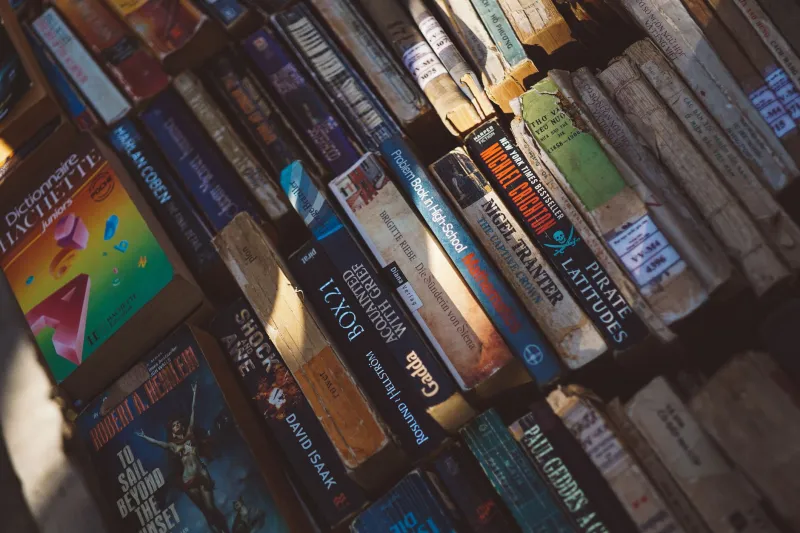
It started, as these things do, in a charity bookshop in a market town with a damp carpet and an excellent tea urn. I paid 80p for a 1991 Pan paperback of a thriller nobody needs, opened it on the bus, and found this on the half-title: 'To Debs. Sorry about the vase. Love always, Uncle Ray, Christmas 1994.'
I read it four times. What vase? How badly broken? Did Debs ever speak to Uncle Ray again? Did she keep the book as a peace offering, or as evidence? Was the book itself a punishment — the cheapest thing on the shelf that still technically counted as a gift?
Nine months and 340 books later, I have a spreadsheet, three ring binders of photographs, and a mild reputation among local booksellers as the man who asks to see the insides of things.
The rules of the archive
This is not a valuable-books project. Antiquarian dealers have their own traditions and they can keep them. My rules are deliberately low-rent:
- The book must have been bought secondhand, in Britain, for under a fiver.
- The inscription must be handwritten, not a printed gift plate.
- I must photograph it before buying, because I am not made of shelf space.
- No book is bought purely for the inscription unless the inscription is extraordinary. (Four exceptions have been made. Two involved a divorce.)
By month nine the index had more columns than a parish council spreadsheet: decade of inscription, relationship implied (aunt, godparent, lover, colleague, 'unknown but tense'), emotional tone, whether the recipient's name appears elsewhere in the book, and a free-text field called 'Vase?' for messages that clearly refer to an incident.
A rough taxonomy, by decade
The 1960s and 1970s are the most formal and, oddly, the most poignant. Fountain pen, faint, horribly disciplined handwriting: 'To Margaret, with best wishes for Christmas and the New Year, from Auntie Joan and Uncle Ted.' No jokes. No clues. The book was a duty, and the duty was performed correctly. These inscriptions almost never mention the book itself, which suggests a certain honesty about the transaction.
In the 1980s, the biro arrives and everything loosens. 'Happy 21st Kev — don't spend it all on lager.' 'To Mum, Happy Birthday, from the one who remembered.' The handwriting slants more. Somebody has drawn a small, bad robin.
By the 1990s, the inscriptions become confessional. This is the apology decade: 'Sorry about the vase', 'Sorry for the thing at the wedding', 'Sorry it's late', 'I know we said we wouldn't do presents.' There is also, unmistakably, an uptick in ironised gift-giving — the joke book given with genuine malice, the diet book inscribed with a level of encouragement that reads, on the third pass, as a declaration of war.
The 2000s and 2010s get stranger in a different way: printed gift cards taped in, Amazon dispatch notes still folded inside, and my personal favourite, a 2013 inscription reading simply 'From your list. Happy Birthday. — L.' The gift has been offloaded; the obligation has been met; the personal touch has been outsourced to an algorithm.
The 2020s are nearly silent. Fewer handwritten inscriptions, more pristine unread hardbacks, more books that were clearly bought in a hurry from a supermarket display table in December. I am told this is because of e-readers. I suspect it is also because we have all become less willing to commit ink to sentiment in case someone photographs it for a website.
The Debs Problem
Eleven books in the index are inscribed to a Debs. This is a statistically improbable number of Debs, given the sample size, and I have decided not to investigate it too hard.
Most are ordinary: 'To Debs, Happy Christmas 1998, love Nan.' But two are not. One, in a 1974 Virago paperback, reads in confident blue biro: 'Debs — you know why. M.' Another, pencilled inside a 1989 cookery book, says: 'Debs. Read this and think about what you did.'
That second one has followed me around for months. The cookery book is about casseroles. What did Debs do with a casserole?
What the booksellers say
I have been gently tolerated in four charity shops and one proper secondhand bookshop. The consensus, from people who have handled thousands of these, is that inscriptions barely affect the price — but they affect the decision.
A bookseller in Sheffield told me she had stopped removing them. 'We used to rub out pencil ones because it looked tidier. Now I leave them. People want the ghost.' A volunteer in Norfolk said she sometimes puts a book back on the shelf after reading the inscription, 'because it feels like it belongs to someone else still.' And a dealer in Bristol, who asked me not to name his shop, said the ones that unsettle him are the love notes: 'Not the soppy ones. The ones where you can tell they meant it. You can't put a price on a stranger's sincerity, so we usually knock 50p off.'
Why we shed the books, and keep the notes
Here is my grand theory, offered free of charge: we do not throw away books, we de-accession them. And we do it in the specific British way of leaving them somewhere to be found by someone else, so that the responsibility is transferred rather than discharged.
The inscription is the proof that the object was once a relationship. Removing the book is fine. Removing the inscription would be vandalism, so nobody does. And so a message meant for Margaret in 1972 ends up being read by a man on a bus in 2026, who then tells other people about it, which is either a small act of preservation or a very slow-motion breach of privacy. I have decided it is the first one.
If you find a good one — and you will, if you open the front of the book instead of just checking the price — photograph it before you decide anything. Do not steal the inscription off the shelf. Do not pay over the odds. It is worth, in the end, exactly 80p and a paragraph of your day.