The Leylandii Accords: A Spotter’s Guide to Britain’s Greenest Cold War
Somewhere near you, at this very moment, a hedge is being discussed in lowered voices. Not the weather. Not the bins. The hedge. It stands there, green and impassive, quietly holding the line between your bit and their bit, and it has opinions. So do the neighbours. So, eventually, does the council.
The British hedge is many things: a windbreak, a bird hotel, a privacy screen, a passive-aggressive handshake rendered in foliage. It is also the closest thing suburban Britain has to a diplomatic corps. This is a spotter’s guide.
The Green Handshake
A fence is blunt. A fence says: this is mine, that is yours, and I have measured it. A hedge is more nuanced. A hedge says: this is mine, but I have made an effort, and I would like you to notice the effort without either of us having to mention it. It is a boundary that performs politeness.
Which is why hedge disputes feel so personal. You are not arguing about vegetation. You are arguing about whether the green handshake has been respected. Was it trimmed on your side or theirs? Was the overhang pushed back or merely frowned at? Did someone — and we are not naming names — let it creep above the two-metre mark and then go on holiday?
A Rough Taxonomy of the British Hedge
Privet. The people’s hedge. Forgiving, fast, faintly dusty, and possessed of a smell that instantly returns you to a childhood street where someone’s dad was always strimming. Privet is the hedge equivalent of a reliable hatchback.
Leylandii. The accelerated monolith. Grows a foot a year if you look at it encouragingly. Beloved of people who want privacy yesterday, feared by people who want light tomorrow. It is the hedge most likely to have its own council case file.
Box and yew. The topiary classes. Slow, dense, and slightly smug. These are hedges with ambitions and, often, a set of shears kept in a special tin.
Beech. The sensible one. Holds its rust-coloured leaves through winter, looks handsome in frost, and never causes a scene. The hedge you would want on a committee.
Hawthorn. The agricultural original. Prickly, wildlife-friendly, and entirely uninterested in your suburban aesthetics. Excellent for birds, less excellent for retrieving a football.
Laurel. Glossy, generous, and a bit thuggish. Grows vigorously, smells of marzipan when cut, and will happily annex a corner of the lawn if you turn your back.
The Unwritten Rules of the Snip
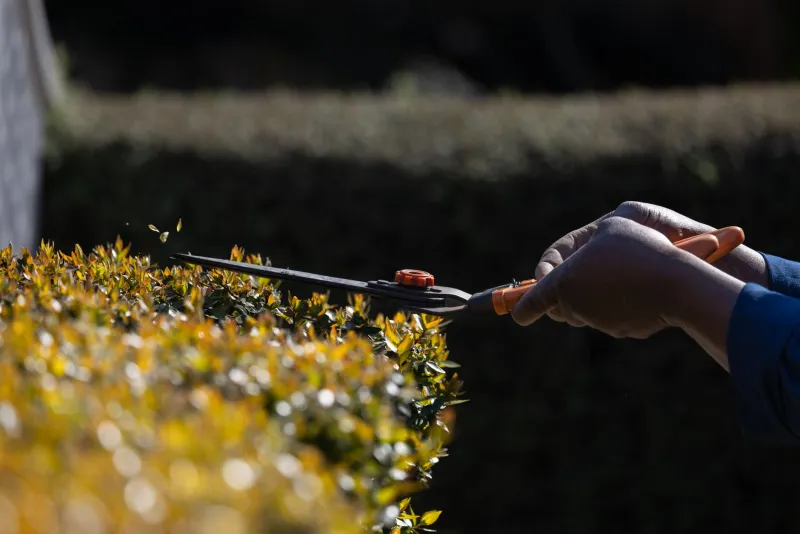
Here is where the quiet war is fought. The law, broadly, says you may trim your side and any overhang back to the boundary line — but you should offer the clippings back, because they are, technically, the neighbour’s property. Most people do not want the clippings back. Most people want the clippings to vanish into the green waste bin with dignity.
There is also the nesting season. Between March and August, hedge cutting is a gamble; the Wildlife and Countryside Act 1981 protects active nests, and a petrol trimmer is not a subtle instrument. The wise gardener checks first and feels quietly virtuous afterwards.
Height is the great unspoken. There is no blanket legal maximum for a garden hedge in England and Wales, but Part 8 of the Anti-social Behaviour Act 2003 gives councils a route to act on evergreen hedges over two metres that are blocking light. The two-metre line has therefore become folklore: half rule, half threat, wholly British.
When Diplomacy Fails
“He trimmed it at dawn,” says Margaret, 68, an allotment holder in Leicestershire. “On a Sunday. With a petrol trimmer. I knew then it was war. We are polite now, but the hedge knows.”
“We have a WhatsApp group called Hedgewatch,” says Dev, a suburban gardener in Surrey. “It started as a joke about whose leylandii was tallest. It is no longer entirely a joke. My neighbour sent a photograph of my overhang at 7:12am with no message. Just the photograph.”
This is the hedge dispute in its purest form: not a row, but a series of calibrated gestures. A photograph. A deliberate trim. A comment about how lovely the light used to be in the kitchen. Nobody says the word “boundary”. Everybody means it.
Topiary and the Art of Quiet Showing Off
Then there is the other wing of hedge culture: the people who look at a shrub and see a teapot. Or a spiral. Or, in one memorable case, a reasonably convincing peacock that has since been described by a neighbour as “a bit more pheasant, really”.
Topiary is horticultural origami with a five-year feedback loop. It is also the most socially acceptable form of showing off in Britain: you cannot boast about your holiday, your car, or your children’s exam results without someone quietly judging you, but you can absolutely sculpt a box hedge into a corkscrew and everyone will say “well, that’s a bit of effort” in a tone that is 40% admiration and 60% suspicion.
Allotment topiary is a genre of its own. Less peacock, more teapot. Less Versailles, more “I found this shape and I’m committing to it”. The ambition is real; the shears are often borrowed; the results are reviewed by a committee of retired men with strong opinions and folding chairs.
The Allotment Variation
Allotment hedges are a different treaty altogether. They do not divide neighbours so much as hold back chaos. They are part bramble, part optimism, and part a message to the site secretary that you are, in fact, maintaining your plot, thank you very much.
“Our hedge is mostly blackberry and good intentions,” says Margaret. “We cut it back in October and by June it has forgiven us and grown again. It is the only thing on the allotment that never needs watering and never listens to advice.”
A Modest Conclusion, With Tea
The hedge is a compromise you can prune. It will never be perfect; it will never be finished; and it will always be slightly taller on the side you do not own. That is not a failure. That is the deal.
So make a brew, look out of the window, and admire the green wall. Then check whether it needs a trim. Probably not today. Possibly not tomorrow. But soon — and when you do, do it considerately, check for nests, and remember: the neighbour is watching, and they have a WhatsApp group.