The Front Garden Parliament: Notes from a Very Unofficial Gnome Census
Every neighbourhood has one: a front garden that has quietly become a constituency. Not the tidy one with the razor-edged lawn and the single recyclable bin, but the other one. The patch with a stone heron staring down the pavement, three gnomes in conference by the hydrangeas and a frog that seems to have moved two doors down since Tuesday. Welcome to Britain’s front-garden sculpture economy, a semi-public gallery with no opening hours, no gift shop and an unusually high rate of unexplained relocation.
As of November 2026, I have conducted what can only be described as an extremely unofficial census. It involved tea, a notebook, several awkward glances from people washing cars and one delicate conversation about whether a ceramic mushroom counts as wildlife. The findings are not peer-reviewed. They are, however, deeply British.
Why the front garden is Britain’s least-secret gallery
The front garden occupies a strange place in the national imagination. It is private property, but also a public statement. It says: I am the sort of person who owns a windmill. Or: I have reconciled myself to the fact that a concrete badger is the closest I will get to a water feature. Unlike a back garden, which can be happily neglected behind a fence, the front garden is performed. It is street theatre with shrubbery.
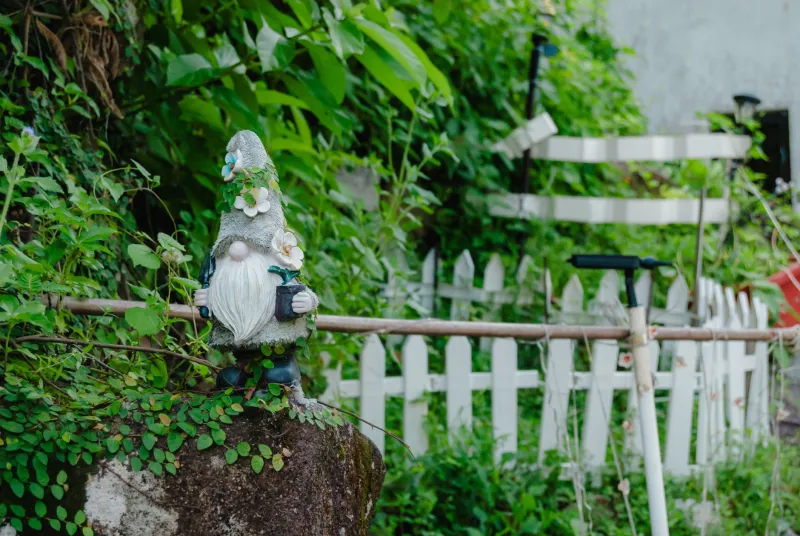
Gnomes fit this brief perfectly. They are small, weatherproof and faintly ridiculous. A stone heron adds dignity; a gnome adds personality; a frog on a rock adds the suggestion that something has gone slightly wrong, which is often the most interesting thing about a garden. None of these objects are expensive enough to be intimidating, but they are visible enough to be discussed. They are the front garden equivalent of a bumper sticker, if a bumper sticker had a pointy hat and a tiny wheelbarrow.
Provenance: car boots, garden centres and the odd inherited heron
Ask where a gnome came from and you will rarely get a straight answer. The official origin story is usually a garden centre, a car-boot sale or a well-meaning aunt. The unofficial story may involve a raffle, a house clearance, a neighbour’s decluttering or a moment of weakness during a bank holiday weekend. Some ornaments arrive with receipts. Others arrive with a look in their eye that suggests they have seen things.
The stone heron is a particular case. It appears to be the only garden ornament that can be inherited without anyone mentioning it. One day there is a heron by the pond. The next, the pond is gone, the heron remains and nobody can remember who bought it. It stands there like a minor deity of damp corners, silently judging the recycling arrangements.
Naming conventions and the politics of the pointy hat
Gnomes get named. This is not optional. A gnome without a name is just a garden ornament; a gnome with a name is a character in the street’s ongoing soap opera. Common names include Cyril, Doris, Brian, Kevin and, for reasons no one has fully explained, Trevor. The name is usually assigned by a child, a grandmother or a neighbour who has had a glass of wine and strong opinions about the layout.
Naming rights can be contentious. If a gnome is bought by one household but regularly admired by another, who gets to name it? If it is moved during a tidy-up, does the name travel with it? And what happens when a gnome is replaced by a newer, glossier model? The old one is rarely retired with honours. It is moved to the side, given a less prominent role and allowed to become background talent. The front garden has a brutal casting system.
Migration, theft and the folklore of return
Here is where the front-garden economy becomes genuinely mysterious. Ornaments move. A frog appears on a wall two doors down. A gnome is found facing the wrong way. A small concrete rabbit turns up at a bus stop, which is either vandalism or a very specific form of public art.
Local folklore usually explains this as theft-and-return. The story goes like this: somebody takes a gnome as a prank, feels guilty, returns it a week later and pretends it was the wind. The gnome is then found in a slightly different position, which is taken as evidence of a night out. Some streets have elaborate legends about a gnome that commutes. Others have a frog that has been returned so many times it now has a reputation for wanderlust.
The truth is probably more mundane. People move things while gardening. Children relocate them. Someone mistakes a neighbour’s ornament for their own after a barbecue. But the folklore persists because it is more fun than the truth. A front garden with a suspected gnome-napper is a front garden with a story.
How to spot a gnome with a backstory
You do not need specialist equipment. A cup of tea and a casual stroll will do. Look for the following signs:
- A gnome positioned slightly off-centre, as if it has just arrived and is waiting to be introduced.
- A stone heron facing a direction that makes no sense for drainage or decoration.
- A frog with a small chip on one foot, suggesting a previous life on a car-boot table.
- A name written on the base in faded marker pen, usually in capital letters.
- A gnome that is cleaner than the others, as if recently returned from an unexplained absence.
- A gap in the arrangement where something clearly used to stand, now occupied by a single sad pot.
If you spot three or more of these signs, you are probably looking at a garden with a full oral history. Do not knock and ask about it unless you have time for a long conversation and possibly a biscuit.
A modest census method
My own method was simple. I walked the same street three times, noted every ornament and tried not to look like a person casing the joint. The results were inconclusive but enjoyable. I counted eleven gnomes, four frogs, two herons, one unexplained concrete mushroom and a small windmill that may have been a bird feeder. By the third walk, one gnome had moved half a metre to the left. Nobody admitted anything. The street said nothing, which in Britain is as good as a confession.
So the next time you pass a front garden with a gnome in it, do not simply walk by. Give it a nod. It may be a cheap ornament. It may be a raffle prize. But it is also part of the great, slightly ridiculous, deeply local economy of British front gardens — a parliament of pointy hats, stone birds and suspiciously mobile frogs.