The Biro Archive: Sorting Car-Boot Cassettes by Genre, Mystery and Mild Shame
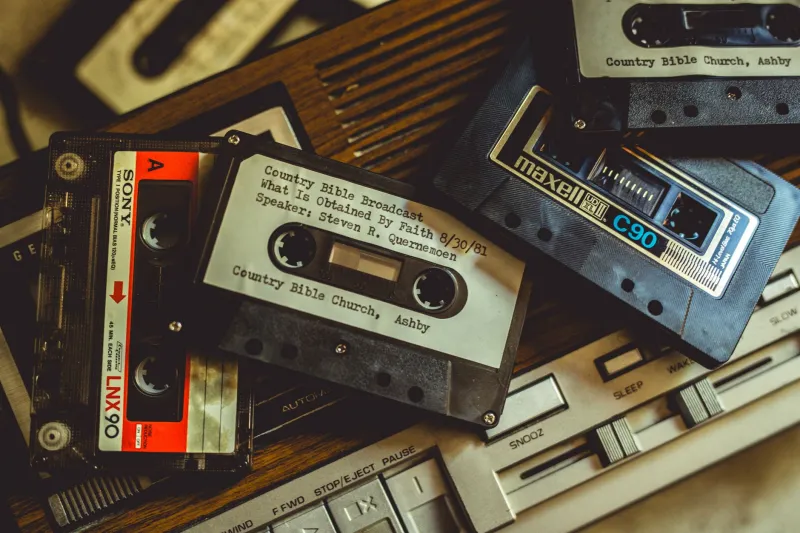
The car-boot sale starts at seven, which is early enough to make you question your life choices and late enough that the good stuff has already been bought by a man with a van and no discernible sense of shame. I went for a lamp. I came back with forty-one cassette tapes, a flask of tea that had gone slightly metallic, and a new project I did not need.
The project is called the Biro Archive. It is not a music collection. It is a cataloguing exercise devoted to the labels: the biro, the Sharpie, the Tipp-Ex, the mysterious initials, the track listings that begin with confidence and end with 'and some others'. At Junocrates, we like a project that starts as a joke and then quietly takes over the dining table. This one has a spreadsheet.
The rules of the crate
Every tape is assessed on three axes: genre, mystery and emotional weight. Genre is easy enough, in theory. Mystery covers anything from a blank label to a single word such as 'Car' or 'Good'. Emotional weight is the difficult one. It covers dedications, dates, crossings-out, and the specific sadness of a tape labelled 'For Mum' that has ended up in a cardboard box next to a broken strimmer.
I paid between 20p and a pound for most of them. The seller looked at me as if I had asked to buy his lawn. That is the correct car-boot response. You do not explain the project. You hand over the money, put the tapes in a carrier bag, and walk away before anyone asks why you are photographing a TDK C90 with the care of a museum curator.
Side A: labels that tell you everything
Some labels are miniature autobiographies. 'Driving Tape 2 – do not play in Mum’s car' is a whole family dynamic in nine words. 'Party ’96 (Sara’s) – NOT FOR SIMON' is a novel with a sequel. 'Aerobics 1' is a threat. 'Wedding – do not record over' is a plea from someone who knew exactly what would happen next.
The handwriting matters. A neat label in blue biro suggests optimism. A label in black marker that has bled into the plastic suggests haste. Tipp-Ex is the great palimpsest of British domestic life: you can usually make out the ghost of the previous title underneath, like a regret. One tape had three attempts at a track listing and then the word 'MIX' written very large, as if to close the matter.
Side B: labels that tell you nothing
Then there are the blanks. A tape with no label at all is not empty; it is a gamble. It might be a radio recording of a chart show from 1993, a church sermon, a language course in French that never got past lesson two, or forty-five minutes of a kettle boiling in another room. I have learned to enjoy the not-knowing. It is the closest I get to streaming without an algorithm.
Some labels are deliberately unhelpful. 'A' is not a title; it is a challenge. 'Good' is a value judgement, not information. '???' is honesty. My favourite so far is a tape labelled 'THIS ONE' in red biro, with no other context. This one what? This one is the one. This one is not the other one. This one contains the secret. I have not played it yet. I am saving it for a rainy Tuesday.
The accidental diary problem
The J-cards – the paper inserts inside the case – are where the project gets emotionally complicated. People wrote things there. Dedications. Dates. Shopping lists. A phone number with no area code. 'For Dad, Father’s Day 1994.' A small drawing of a cat. A note that says 'Sara – bring back my good scissors' in a hand that is clearly not Sara’s.
This is the part where a sensible person stops and puts the tapes back in the box. I have instead started a second spreadsheet column called 'human residue'. It is not a scientific term. It is, however, accurate. These are the traces of people who once made a tape for someone else, and then life happened, and now I am holding it in my kitchen in 2026, wondering whether the cat was called Trevor.
Genre: what Britain actually sounded like, one C90 at a time
Most of the tapes are not albums. They are compilations taped off the radio, with the DJ talking over the intro. They are Now That’s What I Call Music volumes copied onto cheaper tape. They are a wedding band, a church choir, a recorded-off-the-telly theme tune, a language lesson, a fitness class, and side two of something by Wet Wet Wet. Britain’s taste, in other words: enthusiastic, thrifty, and only occasionally embarrassing.
I have sorted them into boxes: Pop, Rock, Classical-ish, Church, Language, Exercise, Mystery, and Mild Shame. The last box is mostly relaxation tapes and a cassette called 'Windows 95 Companion'. I do not know what it does. I am afraid to find out.
Why keep doing it?
Because a car boot sale is the last place in Britain where you can buy a stranger’s memory for 50p and no one asks for a password. Because a handwritten label is a small act of hope: someone thought this tape was worth keeping, or at least worth lending. Because in 2026, when everything is streamed and sorted and recommended back to us, there is something quietly satisfying about a box of unlabelled C90s and a flask of tea going cold while you decide whether 'Dance Mix 3' belongs in Pop or Mystery.
The Biro Archive is not finished. It may never be finished. That is the point. There is always another crate, another label, another tape with 'DO NOT PLAY' written on it in biro. Naturally, I played it. It was forty minutes of someone’s washing machine. I filed it under Experimental.